





Managed AI Outreach
Managed AI Outreach Services for Responsible Follow-Up
NORANGO can help design a managed outbound workflow around a lawful purpose, approved contact data, agreed scripts and clear escalation rules. Jessica handles configured conversations while your team retains control of consent, offer, policy and the next action.
Outreach Begins With a Legitimate Purpose
Outbound contact should start with a defined audience, a lawful basis, an approved message and a useful next step. NORANGO does not turn an unqualified list into an indiscriminate calling campaign. We work with your team to understand why contact is appropriate, what the recipient has agreed to, which records must be excluded and what Jessica is permitted to say.
The same discipline applies whether the workflow follows up an opted-in enquiry, reminds an existing customer about an appointment, confirms an approved service update or reconnects with a contact under a documented business process. The client remains responsible for the audience, proposition and legal basis; NORANGO configures the agreed conversation and operational controls.
From Contact Record to Agreed Next Step
A useful outreach workflow is a sequence of controlled decisions rather than one generic script. Data enters from an approved source, eligibility is checked, a configured attempt is made, the conversation follows the permitted path and the result is recorded for the receiving team.
- Confirm the campaign purpose, audience, lawful basis and suppression requirements.
- Map the minimum fields Jessica needs, such as name, enquiry context, appointment or account reference.
- Approve the introduction, disclosure, questions, objection boundaries and escalation points.
- Define calling windows, attempt limits, unavailable-recipient handling and opt-out treatment.
- Record the agreed outcome, route the next action and review exceptions with a person.
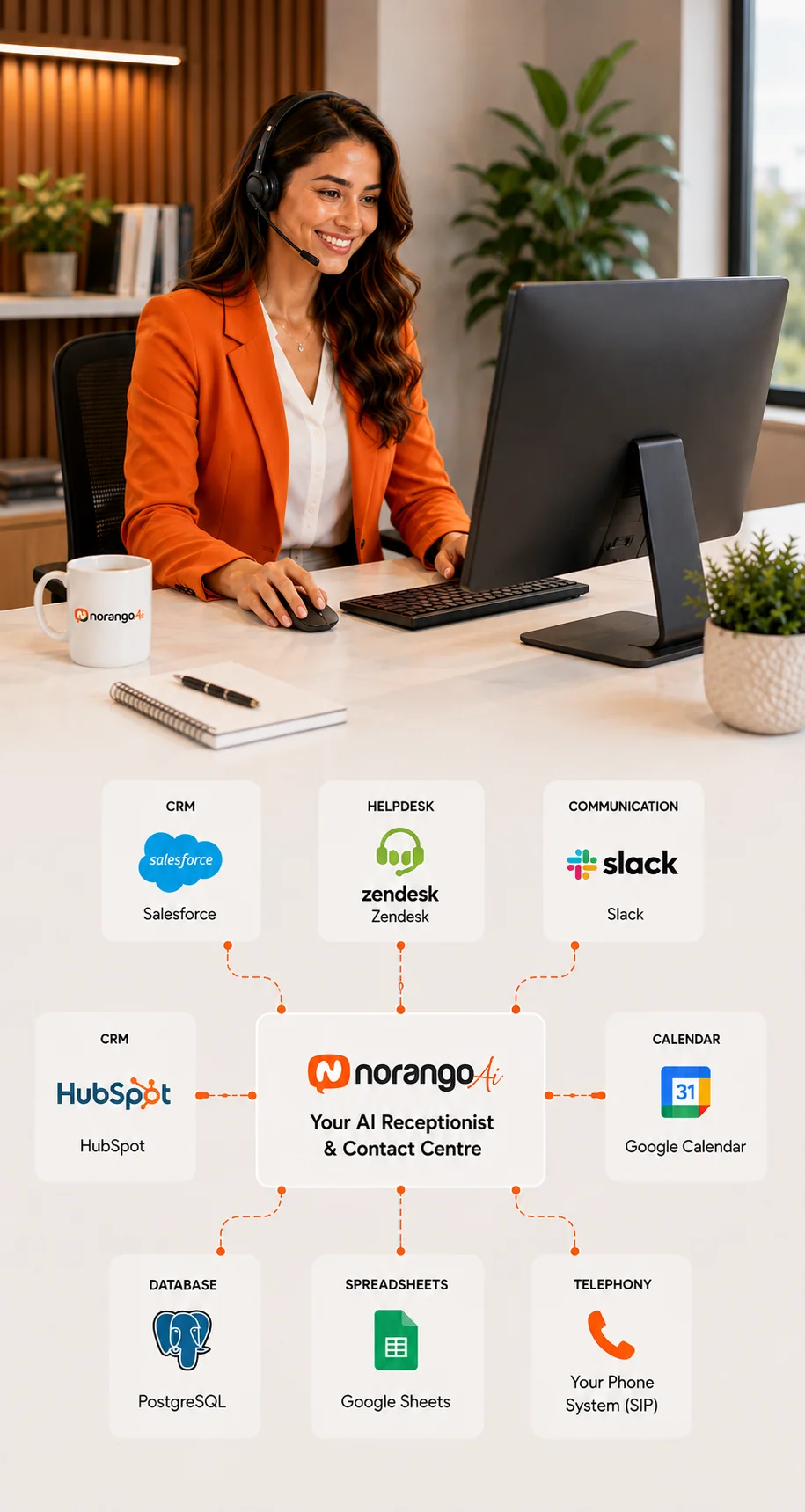
Where access and field mapping are supported, the workflow can exchange agreed information with a CRM, calendar or other connected system. A spreadsheet or controlled file may also be suitable for a bounded pilot. The selected method should minimise unnecessary data and make reconciliation possible.
Use Cases With Different Risk and Context
Not every outbound conversation should be treated in the same way. A callback requested on a form has a different context from a renewal reminder, an appointment confirmation or a safety-related notification. Each use case needs its own audience rules, script, timing, identity checks and escalation path.
| Use case | Configured role | Important boundary |
|---|---|---|
| Opted-in enquiry follow-up | Confirm the enquiry, collect agreed qualification details and offer the next approved action | Use the consent and context attached to the form; do not broaden the purpose without authority |
| Appointment or service reminder | Confirm, reschedule or route a question under the approved process | Apply identity, privacy and cancellation rules appropriate to the service |
| Dormant-enquiry review | Ask whether the earlier need remains relevant and record the response | Check retention, suppression and re-contact rules before inclusion |
| Customer update | Communicate approved information and capture acknowledgement or a question | Do not improvise policy, contractual or professional advice |
| Product or service alert | Follow the approved notice and escalate exceptions | The responsible organisation owns the instruction, eligibility and safety decision |
Consent, Suppression and Respectful Calling
Responsible outreach needs controls that operate before, during and after a call. The design should account for Telephone Preference Service screening where applicable, internal do-not-call records, withdrawn consent, duplicate contacts, unsuitable times, incorrect numbers and requests for a person.
A recipient should be able to understand who is calling, why the contact is being made and how to decline further outreach. Opt-out results should be recorded promptly in the agreed system so that later activity can respect them. Calling windows and attempt rules should reflect the audience, location and purpose rather than relying on one universal schedule.
- Use only approved contact sources and the minimum necessary data.
- Apply campaign-specific suppression and duplicate handling before contact.
- State the organisation and purpose clearly in the approved introduction.
- Make opt-out, human-transfer and complaint paths explicit.
- Pause and review unexpected patterns rather than increasing attempts automatically.
Jessica Handles the Configured Conversation
Jessica can follow an approved conversational structure, ask permitted questions, capture agreed fields and route the next step. She should not be positioned as an autonomous sales strategist, legal adviser or substitute for human judgement. The workflow defines when she continues, when she stops and when a person takes over.
Sensitive, complex or unexpected conversations can be escalated according to the agreed rules. Live support, client-team transfer or a scheduled follow-up may each be appropriate. The handover should include only the context authorised for the receiving team.
The goal is a controlled and reviewable next step—not a promise that every contact will answer, qualify or convert.
Pilot Before Expanding the Workflow
A bounded pilot creates evidence before a broader rollout. Start with one audience, one purpose, a reviewed script, defined attempt rules and a small set of outcomes. Listen to exceptions, compare records and refine the design before increasing volume or adding channels.
The pilot acceptance criteria can include data accuracy, suppression performance, call disposition quality, transfer success, recipient feedback and the time required for human review. Expansion should depend on those results and the contracted capacity, not on an assumption that more attempts automatically create more value.
Measure Outcomes Against Your Own Baseline
Reporting should distinguish attempts from conversations and conversations from useful outcomes. The appropriate measures depend on the campaign purpose and should be agreed before activity begins.
| Measure | What it helps answer |
|---|---|
| Eligible records | How many records passed the agreed consent, suppression and data checks? |
| Contact outcomes | Which attempts reached the intended person, failed, requested another time or produced an opt-out? |
| Qualified next steps | Which conversations met the approved criteria for an appointment, transfer or follow-up? |
| Data quality | Were the recorded fields complete, accurate and reconcilable with the source system? |
| Human-review load | How many exceptions needed a person and what should change in the workflow? |
Use a current proposal and agreed measurement plan for commercial decisions. NORANGO's Cost Comparison can help frame broader service costs, while the actual value of an outreach workflow must be assessed against your audience, baseline and verified outcomes.
Connect Outreach to the Rest of the Customer Journey
Outreach is more useful when the next step is clear. A qualified conversation may book an agreed appointment, create a follow-up task, update a supported CRM field or return the recipient to an inbound team. The surrounding service should be designed as carefully as the call itself.
Explore the current AI Receptionist UK proposition for inbound handling, review Integrations for supported connection patterns, and read the AI Outbound Calling Guide for the informational context behind responsible follow-up. A 30-Day Free Trial can be discussed for eligible inbound services; any outreach pilot, pricing and setup must be confirmed in a current proposal. The Product Recall Response page shows how approved messages and escalation rules can be separated from the responsible organisation's decisions.
Managed AI outreach FAQs.
What is a managed AI outreach service?
It is a configured outbound workflow in which approved contact data, scripts, calling rules, outcomes and escalation paths are agreed before activity begins. Jessica can handle the permitted conversation while NORANGO and the client review exceptions and results.
Can NORANGO call any list we provide?
No list should be treated as automatically suitable. The client must establish the source, purpose, lawful basis, consent position, retention and suppression requirements. NORANGO can help translate those requirements into operational checks.
How quickly can an outreach workflow start?
Timing depends on data quality, legal and consent review, script approval, integrations, voice and transfer design, testing and campaign risk. A current implementation plan should define the pilot and acceptance gates rather than promising a universal launch time.
Can Jessica book appointments or update a CRM?
Agreed actions can be configured where the relevant calendar or CRM is supported, access is authorised and field mapping is tested. The approved workflow determines what Jessica may create, update or route.
How are opt-outs handled?
The script should provide a clear way to decline further contact. The result is recorded in the agreed system and applied to future activity according to the campaign's suppression process.
Does the service promise appointments or conversions?
No. Outcomes depend on the audience, purpose, offer, data, timing and recipient response. A pilot can measure actual contact and qualified-next-step results against an agreed baseline.
What happens when a conversation becomes sensitive or unexpected?
The workflow should define stop, transfer and follow-up rules. Depending on the context, Jessica can escalate to live support, the client's team or an agreed scheduled response rather than improvising beyond the approved scope.